Glycogen synthase kinase 3 beta (GSK-3β) is an attractive
target for the treatment of psychiatric disorders and neurodegenerative
diseases. Many GSK-3β inhibitors have been developed for the treatment
of different central nervous system disorders. But, for an effective
therapy, high IC50 values should be avoided and ATP-competition should
be reduced during enzyme-compound binding. Studies suggested that ATP
non-competitive GSK-3 inhibitors such covalent inhibitors and allosteric
modulators are emerging as a promising approach with better efficacy
and safety.
Despite of many GSK-3β inhibitors in clinical
studies, many challenges still remains. In a clinical study, certain
adverse events caused by off-target activity of GSK-3β inhibitors were
determined after the screening of compounds that bind to the
ATP-competitive binding site conserved across a broad range of kinases.
Thus, there is an urgent need of development of GSK-3β inhibitors that
can selectively target individual pathways and differentiate between the
non-phosphorylated and phosphorylated GSK-3β.
Company
like AMO Pharma Ltd. is in the process of developing AMO-02 as a small
molecule which acts as a GSK-3β inhibitor for the treatment of
congenital myotonic dystrophy.
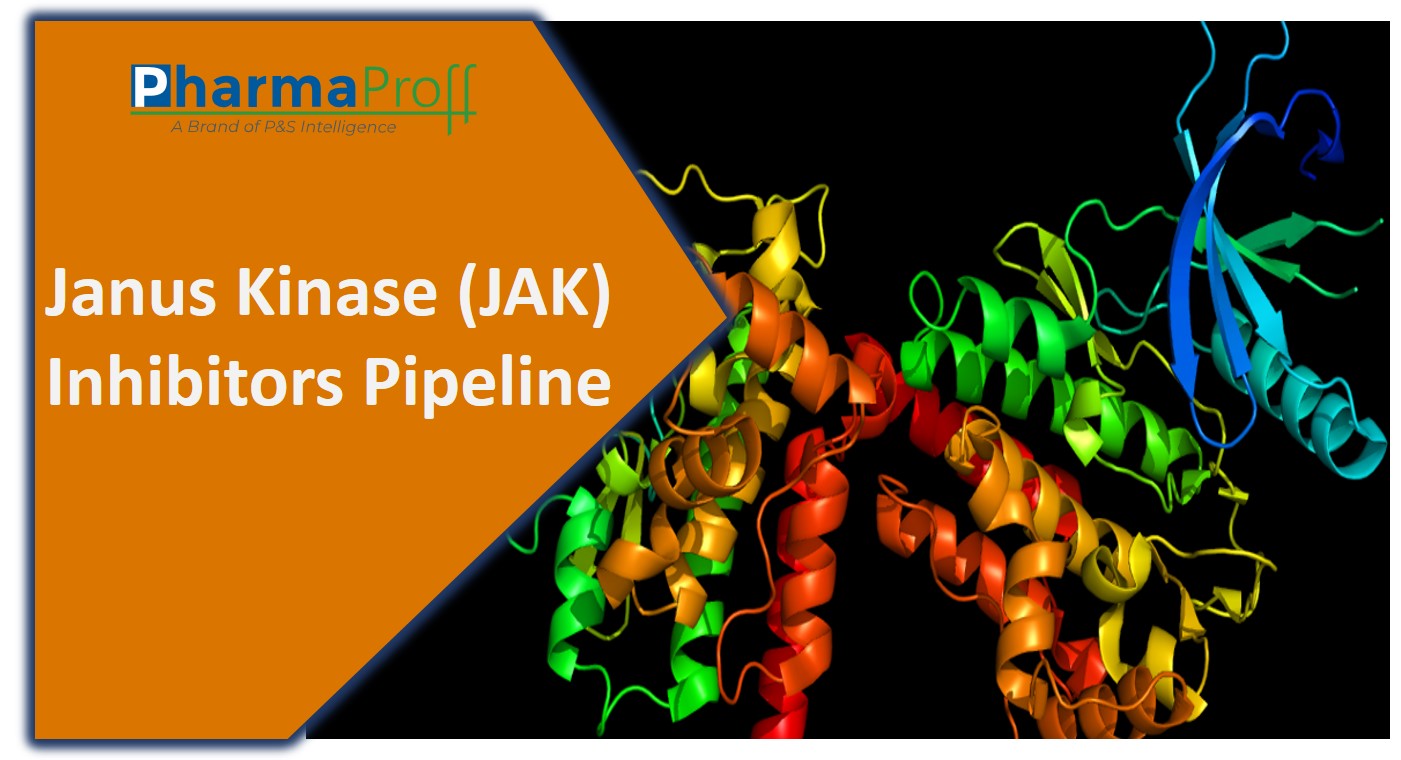
JAK comprises four receptors JAK1, JAK2, JAK3, and
tyrosine kinase 2 (TYK2) which help in cytokine mediated signaling through the
JAK/STAT pathway. There are two nearly identical phosphate transferring domains
present in JAKs. The first domain demonstrates kinase activity while the other
regulates the activity of the first via negative inhibition. The mutations in
the JAK/STAT pathway leads to different medical conditions.
The JAK inhibitors work by blocking the cytokine
mediated signaling via JAK/STAT pathway which plays an important role in immune
regulation and growth.
The pipeline of JAK inhibitors is quite robust with drugs being developed in the Pre-Registration, Phase III, Phase II, Phase I, Pre-Clinical, and Discovery stage of development. Also, majority of the pipeline products are currently undergoing Phase II clinical studies.
According to the research findings, majority of the JAK inhibitors in the pipeline are being developed for oral administration. It has been observed that the oral route of medication is convenient, available in delayed or rapid release formulation, less risk of systemic infections, and inexpensive in nature, and also provides improved patient’s compliance. Moreover, the drugs administered by this route are less invasive and can be modified for extended release, thereby increasing the bioavailability. Also, administration of JAK inhibitors through oral route have shown promising results in the clinical studies.
The companies developing JAK inhibitors have shown
positive clinical results in the various phases of drug development. For
instance, in January 2018, LEO Pharma A/S’s collaborator Japan Tobacco Inc. and
Torii Pharmaceutical Co. Ltd. announced the topline results from delgocitinib’s
Phase III comparative study. The primary endpoints of the study were met and
there were no clinically significant findings on safety and tolerability of
delgocitinib within the treatment period. Similarly, Astellas Pharma Inc. in
February 2018, announced results of two-Phase II trials on peficitinib wherein
the drug demonstrated superiority over the placebo w.r.t the primary endpoints.
Also, the safety profile of Peficitinib was found to be consistent.
In the wake of various strategic development
activities, Theravance Biopharma Inc. and Janssen Global LLC signed an
agreement in February 2018 to jointly develop and commercialize Phase I
product, TD-1473. Similarly, Galapagos NV and Gilead Sciences Inc. in December
2015 signed a partnership agreement to develop and commercialize filgotinib for
the treatment of rheumatoid arthritis and Crohn’s disease. Therefore,
collaborating and partnering with other companies can help the current players
in the pipeline to expand their drug portfolio for the treatment of diseases
related to the JAK/STAT pathway.
Pfizer Inc., Eli Lilly and Company, Incyte Corporation,
AbbVie Inc., Concert Pharmaceuticals Inc., Portola Pharmaceuticals Inc.,
Italfarmaco S.p.A, CTI BioPharma Corp., Theravance Biopharma Inc., Janssen
Global LLC, and Galapagos NV are some of the companies involved in the
development of JAK inhibitors.